

BIM Surveys: Driving Forces for Sustainability
In an era that is experiencing high degrees of climate change, global warming and daunting environmental concerns, BIM surveys are an important surveying tool that can accurately calculate the required quantities of materials and equipment needed for a project, restraining over-ordering and nonessential waste.
Limiting the harmful impacts of climate change on the world and contributing towards a more sustainable future, BIM surveys play a vital role in the future of planet preservation.
This article will explore what exactly sustainability is, how land surveys adopt sustainable practices and how BIM surveys enhance sustainability upon the planet by encouraging more sustainable construction practices.
Sustainability Through BIM Surveys
Defining Sustainability
Before we dive into sustainability, it’s important to outline what exactly it is, and how we are going about maintaining it for future generations. Above all, sustainability can be defined as practices that support ecological, human and economic health and vitality. As the United Nations’ Brundtland Commission stated in 1987, sustainability is:
“the ability to meet the current needs of society without compromising the future”
Why is sustainability important?
Above all, sustainability contributes to the preservation of our planet so that we have integral resources for the present and future, such as water, clean air and natural resources that we use on a day-to-day basis.
Sustainability regards the present moment, as well as the future, enabling individuals to build a future and cultivate sustainable ways of living altogether.

Sustainable Land Surveys
With both the construction and surveying industries relying on natural resources to flourish, it is important that these green resources are maintained and preserved as best as possible.
This is certainly proving challenging, with both industries creating nearly 40% of ALL carbon emissions altogether.
With further deepening concerts around climate change, now has never been such an important time for both industries alike to reduce their impact on the environment and create a greener future outlook.
As RICS, the Royal Institution of Chartered Surveyors mentioned:
“Acknowledging the climate crisis is no longer enough – we need to act”.
How Do BIM Surveys Promote Sustainability?
The opportunity to visualise buildings long before any work has even been started is possible with BIM, with the architects being able to build both aesthetically pleasing and functional models. These include being able to visualise the precise elements of the structure, such as materials, lighting and building components.
These are the top five ways that BIM surveys encourages sustainability:
1. Accurate BIM Modelling
The increasingly fast data collection from each of the surfaces and objects is aided by the laser scanner, providing architects and engineers with a thorough starting point when creating the BIM model.
Once modelling has started, users can incorporate sustainability measures throughout the entire building. Factors such as ventilation, indoor air quality and heat transfer can be visibly seen upon the screen. Any of these modifications made upon the design can be seen straight upon the screen. If this is wanted to be changed, then modifications are able to be made. Thus, saving endless hours and allowing the projects to move forward more swiftly.
2. Sustainable Building Materials
Another positive aspect of BIM surveys is that they provide deep insights into the environmental impact of different materials, with the various tools enabling both architects and engineers to make more informed decisions, through selecting materials that are sustainable, durable and fitting to each project.
At Merrett Survey, we use recycled materials across our construction projects as much as possible, with BIM enabling us to produce more eco-friendly buildings that project much lower carbon emissions and ameliorate sustainability around the world.
3. Reduce Wastage From Land Surveys
It’s shocking to note that nearly 30% of all building materials that end up on a construction site go to waste.
This ultimately makes the construction industry one of the biggest contributors to waste across all industries. Fortunately, BIM helps to reduce this number significantly.
Responsible for around 23% of air pollution, 40% of drinking water pollution and 50% of landfill waste, the construction industry is paving its way towards a greener future with the implementation and utilisation of BIM as a whole.
4. Faster Building Schedules With BIM
Due to the high efficiency of BIM surveys, their integration can speed up project delivery times considerably and means that projects can be completed in a much smaller timescale.
Level 2 BIM added collaborative working and communication elements, with an information process that is specific to the project and coordinated between different systems and projects.
With faster and more effective processes, information is able to be more easily shared, distributed and acted upon with BIM. This hugely influences sustainability because the shorter the time that is spent working on a site, the less damage that is had upon the land and the least impact that is had on the energy consumption, noise pollution and machinery within the environment itself.
BIM Ensures Future Building Maintenance
Before BIM became a global phenomenon in the surveying industry, contractors had very little to do with the building itself after the work had been completed. But, since BIM was implemented across the surveying industry, the tool remains a critical component of ongoing building maintenance. With the high detail that is available from the BIM models, colossal amounts of information can be passed on to building managers.
From ensuring that the building performance is monitored and recorded, including updating the BIM data when needed, BIM models ensure that well-made decisions are made. In turn, this maximises the sustainability of the building and extends the life-cycle of the structure altogether.
BIM Surveys at Merrett Survey
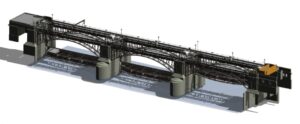
From conducting sustainable BIM surveys at Clyde Tidal Weir to providing detailed scan to BIM surveys, our team have over forty years of BIM experience across the globe.
Start Your Sustainable BIM Survey Journey Today
With the land sector being a major emitter of greenhouse gases, revolutionary change needs to happen as soon as possible.
Contribute towards a greener, more sustainable future by choosing Merrett Survey as your qualified BIM surveyor.
Simply contact us on +44(0)1392 362161 or get in touch with us by sending an email to info@merrettsurvey.com.

Peter Merrett - Owner & CEO
Get in Touch


